From Margins to the Mainstream: Advancing Climate–Health Integration from Copenhagen to WHA78
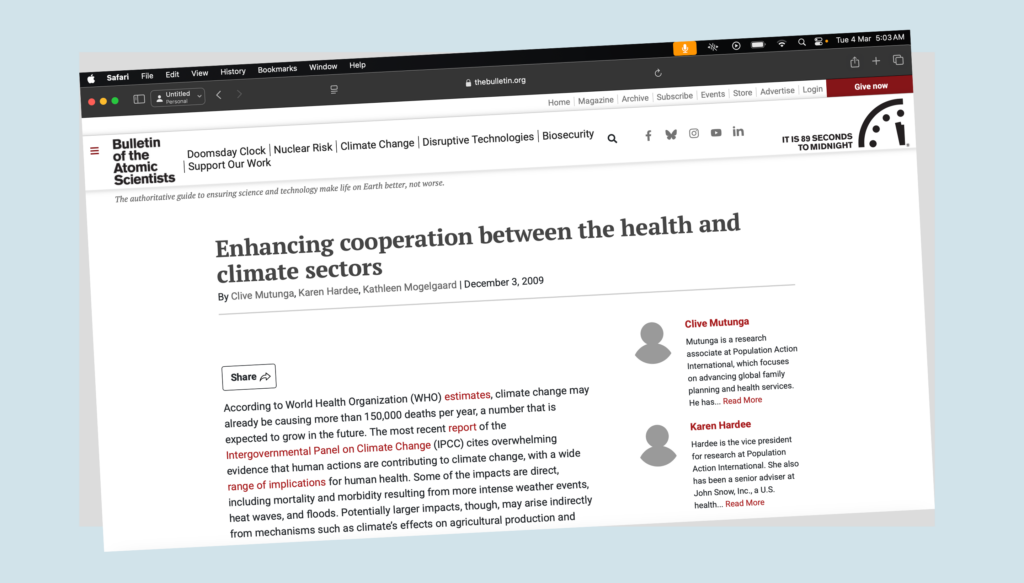
In 2009, I co-authored a policy article titled “Enhancing Cooperation Between the Health and Climate Sectors” alongside Karen Hardee and Kathleen Mogelgaard. At the time, the health impacts of climate change were already evident, yet remained underrepresented in global climate frameworks. We called for closer alignment between the World Health Organization (WHO) and the UN Framework Convention on Climate Change (UNFCCC), stronger investment in health adaptation, and formal recognition of health as a climate issue.
Sixteen years later, as I follow the discussions at the 78th World Health Assembly (WHA78) in Geneva, I’m struck by both how far we’ve come—and how far we still have to go.
Then: Health on the Margins of Climate Policy
Back in 2009, climate change was already contributing to an estimated 150,000 deaths annually, primarily in low-income countries. Yet:
- Health was barely mentioned in national adaptation plans (NAPAs), despite its vulnerability to climate shocks.
- Fewer than half of the least developed countries proposed a single health adaptation project.
- WHO had not been designated as a Global Environment Facility (GEF) agency.
- Health actors were largely absent from climate negotiations—comprising less than 1% of delegates at the UNFCCC’s COP sessions.
We argued that climate resilience starts with public health systems. Strengthening surveillance, emergency preparedness, and community-level services would not only save lives but also position health as a frontline adaptation strategy.
Now: WHA78 and a Watershed Moment for Climate–Health Alignment
This year’s World Health Assembly, themed “One World for Health,” marks a significant pivot. WHA78 is set to adopt the Global Action Plan on Climate Change and Health, a long-overdue framework that places health squarely within the climate agenda.
- Key advancements include:
Integration of health in Nationally Determined Contributions (NDCs) under the Paris Agreement. - Recognition of climate-sensitive diseases, extreme heat, and air pollution as core health threats.
- WHO’s Fourteenth General Programme of Work (2025–2028) prioritizing climate resilience as one of six strategic pillars.
We’re also seeing increased collaboration with actors en route to COP30 in Belém, where health voices will play a more prominent role than ever before.
Progress—and Remaining Gaps
Despite these gains, many of the challenges we identified in 2009 persist:
- Health projects still receive less than 5% of climate adaptation finance globally.
- WHO remains outside the official circle of GEF implementing agencies.
- Health is often siloed, treated as a co-benefit rather than a core driver of resilience.
The fragmentation of climate finance and governance structures continues to hinder cross-sectoral solutions. And while the Global Action Plan provides a strategic roadmap, implementation depends on political will, national leadership, and sustained financing.
A Path Forward
To truly align climate and health, we need to:
- Position health systems as climate infrastructure—worthy of investment in resilience, much like energy grids or water systems.
- Mainstream health across all climate finance mechanisms, including the GEF and Green Climate Fund.
- Embed health expertise in national climate delegations, planning processes, and adaptation platforms.
- Invest in localized data, early warning systems, and climate-informed service delivery.
- Empower ministries of health to lead national dialogues on adaptation priorities, not just participate.
Conclusion: From Advocacy to Action
WHA78 offers a pivotal opportunity to bring health from the sidelines to the center of climate policy. The global health community must seize this moment to shape how we prepare for and respond to climate shocks—not only in Geneva, but in ministries, communities, and clinics across the world.
Our 2009 article was titled “Enhancing Cooperation Between the Health and Climate Sectors.” Today, the call remains the same—but the tools, alliances, and momentum have finally begun to shift.
Let’s turn this alignment into lasting, transformative action.
About the Author
Clive Mutunga is a policy expert and development strategist with over two decades of experience working at the intersection of health, climate change, and sustainable development. He has served in senior advisory roles with organizations such as USAID and has been instrumental in shaping cross-sectoral programs that integrate climate resilience with public health systems. Clive is the founder of CHED Solutions, a consulting firm advancing evidence-based approaches to health, environment, and development policy and programming.